JK Paper consciously reduced its reliance on writing and printing paper; revenue share from packaging board and conversion businesses rose from 23.6% to 41.7%
Join WhatsApp Group, Telegram & YouTube Channel, No Spamming
 Join WhatsApp Group
 Join Telegram Channel
 Join YouTube Channel
 Join Job Channel (View | Submit Jobs)
 Join Buy Sell Channel (Free to Submit)
 Paper News Headlines Channel (Free to read)
JK Paper consciously reduced its reliance on writing and printing paper; revenue share from packaging board and conversion businesses rose from 23.6% to 41.7%
- JK Paper increased its social farm forestry programme at all plant locations to strengthen the availability of adequate raw material
- Focus on emerging new bio-degradable products like aqueous barrier coated Cupstock board, Carry bag and Paper straw etc.
The Pulp and Paper Times
JK Paper continued to solidify its position in the Indian paper industry in FY 24-25. The Company achieved its highest ever sale of 8,06,000 tonnes during the year. Consolidated revenues were higher at Rs 7,120 crores as demand for sustainable paper and packaging solutions increased across our markets. However, significant headwinds in the form of a steep increase in wood cost and lower sales realisation due to rising cheaper imports resulted in a marked profit reduction. This is despite improved operational efficiencies through process innovation, digitalisation and a reduction in energy usage, coupled with enriched product mix.

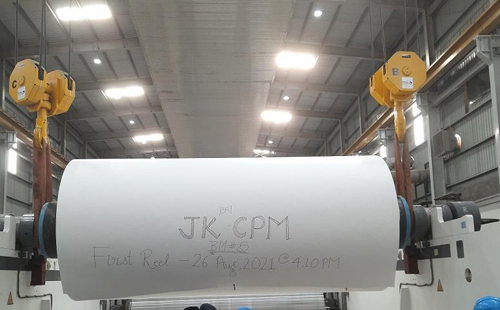
JK Paper operates three state-of the-art manufacturing facilities for paper and packaging board, strategically located close to plantation wood sources and major consumption markets. In addition, it comprises of corrugated conversion units, monocarton units, label production, animal nutrition and Aerospace & Defense business.
In 2024-25, the demand for JK Paper’s products remained resilient despite significant market challenges, particularly in the writing and printing (W&P) and copier paper segments. However, JK Paper sustained decent volumes in W&P by leveraging strong relationships with printers and publishers, offering a wide product range, and successfully converting large tenders. In the copier segment, although high import volumes and intense domestic competition persisted, the Company maintained a price premium owing to its strong Brand presence. The Paperboard market was also intensely competitive due to a flood of low-cost imports, yet JK Paper achieved reasonable growth by focusing on value-added products, launching new offerings, and expanding into untapped export markets. Coated paper demand remained stable overall, though pricing was impacted by increased import activity. Strong ties with converters and distributors across segments further supported volume stability in a challenging pricing environment.

JK Paper continued its leadership in its established product lines while continuing to focus on emerging new bio-degradable products like aqueous barrier coated Cupstock board, Carry bag and Paper straw etc. These products are becoming increasingly popular due to their alignment with customer preferences for eco-friendly options.
The digital transformation journey undertaken by the Company in recent years gained strength and is more entrenched in day-to-day operations across all functions and businesses.
“Our strategic initiatives reinforced our long-term vision of business expansion and diversification to meet growing demand and enhance value for all stakeholders. Our turnover increased ten-fold over the last two decades by way of organic and inorganic growth. Besides growing in the established paper and board business, the Company has emerged as India’s largest organised player in the corrugated packaging sphere and established a footprint in the mono carton and labels business in the last few years. During the year under review, the Company acquired a majority stake in Radhesham Wellpack Private Limited, which has a robust presence in the western region of India, to consolidate its position in the area of corrugated packaging. Your company also acquired a majority stake in Quadragen VetHealth Pvt. Limited, which specialises in animal nutrition products, including Feed Additives & Growth Promoters, a high growth profitable sector,” Mr. Harsh Pati Singhania, Chairman and Managing Director of JK Paper Ltd. stated in the annual report for FY 24-25

Mr. Singhania further informed that, sustainability is a fundamental aspect of our operations. We have consistently implemented eco-friendly practices throughout our production processes, achieved a significant reduction in our carbon footprint, and made considerable advancements toward our objective of becoming a net zero company. The Company’s enhanced operational efficiency is evident in the significant reduction in freshwater consumption,”
At 25.9 m³/MT, the consumption at Unit JKPM is the lowest among all integrated pulp and paper industries in India. The Company continues to decrease its reliance on fossil fuels and lower its carbon footprint. Over the past decade, coal usage decreased by approximately 62%, advancing JK paper progress towards achieving net zero emissions. JK Paper continues to be carbon and wood-positive.

JK Paper increased its social farm forestry programme at all plant locations to strengthen the availability of adequate raw material in the states of Odisha, Gujarat, Andhra Pradesh, Telangana, and Maharashtra. During the year, 13.21 crores saplings were planted, covering more than 87,840 acres. The cumulative coverage of over 780,000 acres of plantation has not only contributed to expanding green cover but also improved livelihoods by benefitting about 1 Lac farmers.
In 2024-25, JK Paper recorded a growth in revenue to Rs. 7,120.20 crores. Profitability and margins moderated due to sharp rise in wood cost and lower selling prices caused by surge in cheaper imports. EBITDA was Rs. 1,036.28 crores and Net Profit stood at Rs. 411.98 crores.

“JK Paper continued to widen and deepen its market coverage. The result of a multi-terrain geographic coverage was an increased resilience to demand shifts; when one region purchased less paper, another region covered up. By seeding micro-markets more effectively, the Company was able to resist the full brunt of the downtrend. Complementing this initiative was the Company’s direct retail presence. The Company’s sales representatives proactively explored markets, engaged existing and potential buyers, and drove demand generation. This shift reduced the Company’s reliance on traditional trade representatives. More significantly, this unconventional strategy reshaped the Company’s identity from being perceived solely as a conventional manufacturer to emerging as a dynamic, market-facing demand catalyst,
“JK Paper broad-based its portfolio towards packaging board and conversion businesses, segments with consistent demand patterns linked to the growth of India’s consumption economy. During the last three years, the proportion of revenues from the packaging board and conversion businesses increased from 23.6% of the Company’s overall revenues to 41.7%. This helped deepen the Company’s de-risking and portfolio competitiveness. During this period, the Company engaged in timely and strategic acquisitions that not only enhanced its footprint in the conversion business but also beyond the paper and packaging business, the full impact of which is expected to play out across the foreseeable future,” the report stated.
A core pillar of the JK Paper’s long-term strategy was portfolio diversification. Over the last five years, the Company consciously reduced its reliance on writing and printing paper by expanding into the packaging board and allied product segments. In the past year, the Company arrived at a strategic milestone by signalling its intention to enter the non-paper products domain viz: animal nutrition, a high growth and high profitable segment.
During the current financial year, JK Paper will commission a 125,000 TPA BCTMP (Bleached Chemi-Thermo Mechanical Pulp) mill to integrate its packaging board segment backward. This initiative will increase the share of internally sourced raw materials, reduce a reliance on imports, and improve cost-efficiency. In turn, this will enhance competitiveness across varied market conditions.
In parallel, the Company is undertaking capacity expansion through process debottlenecking, allowing it to boost output with minimal capital expenditure. This is expected to lower the capital cost per tonne, reinforcing cost leadership and market agility.
Web Title: JK Paper consciously reduced its reliance on writing and printing paper; revenue share from packaging board and conversion businesses rose from 23.6% to 41.7%
More News From india


{{ item.Title }}