Join Groups & Channels, No Spamming









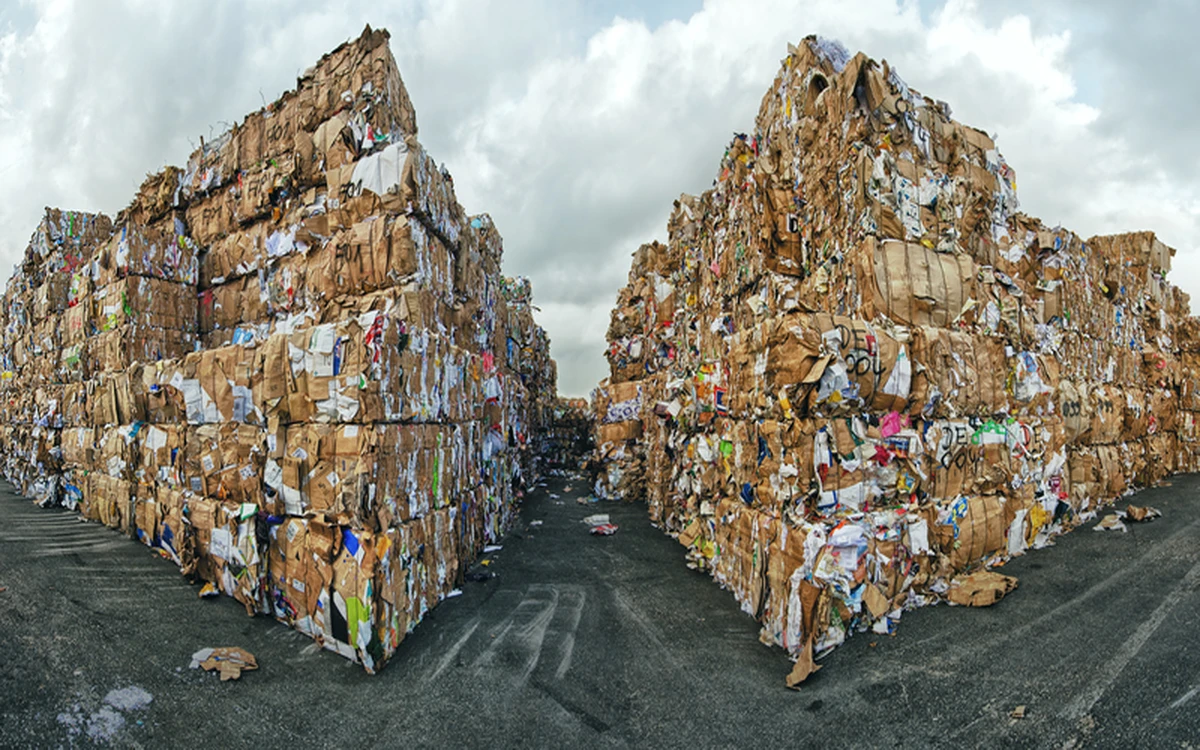
Morbi paper mills see full-capacity operations as ceramic industry revives; Kraft paper exports to China spike, Prices strengthen; Janmashtami shutdown ahead

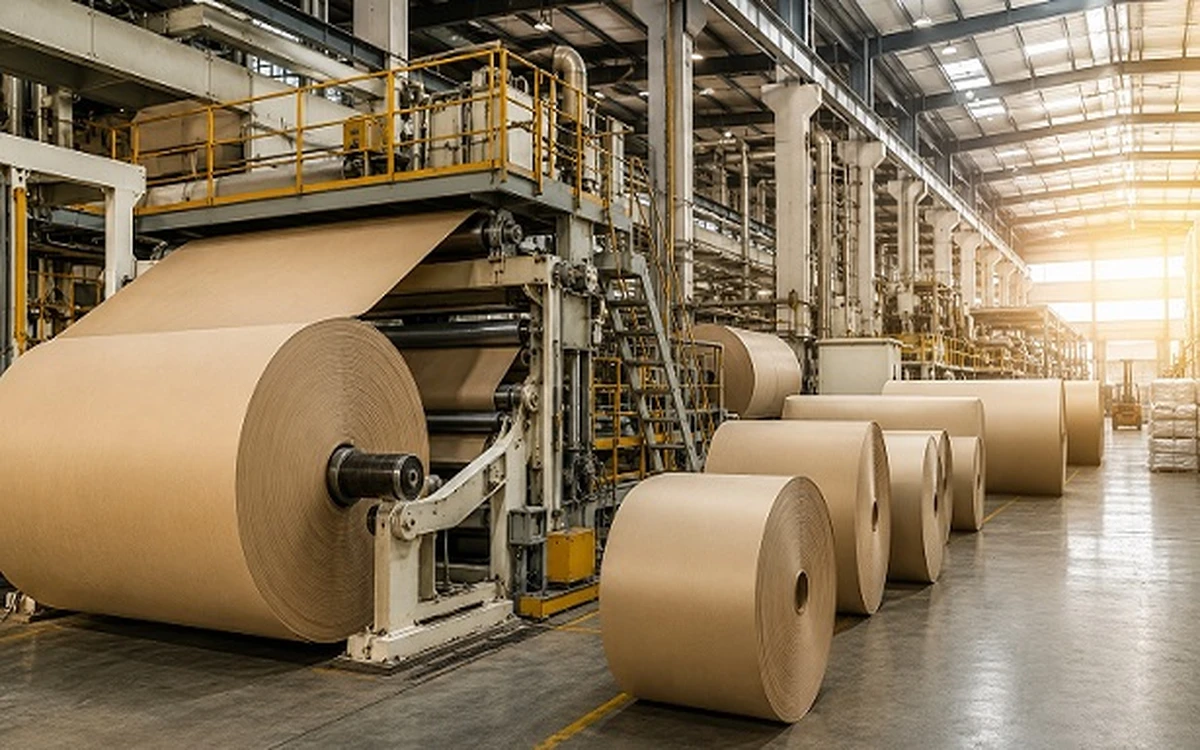
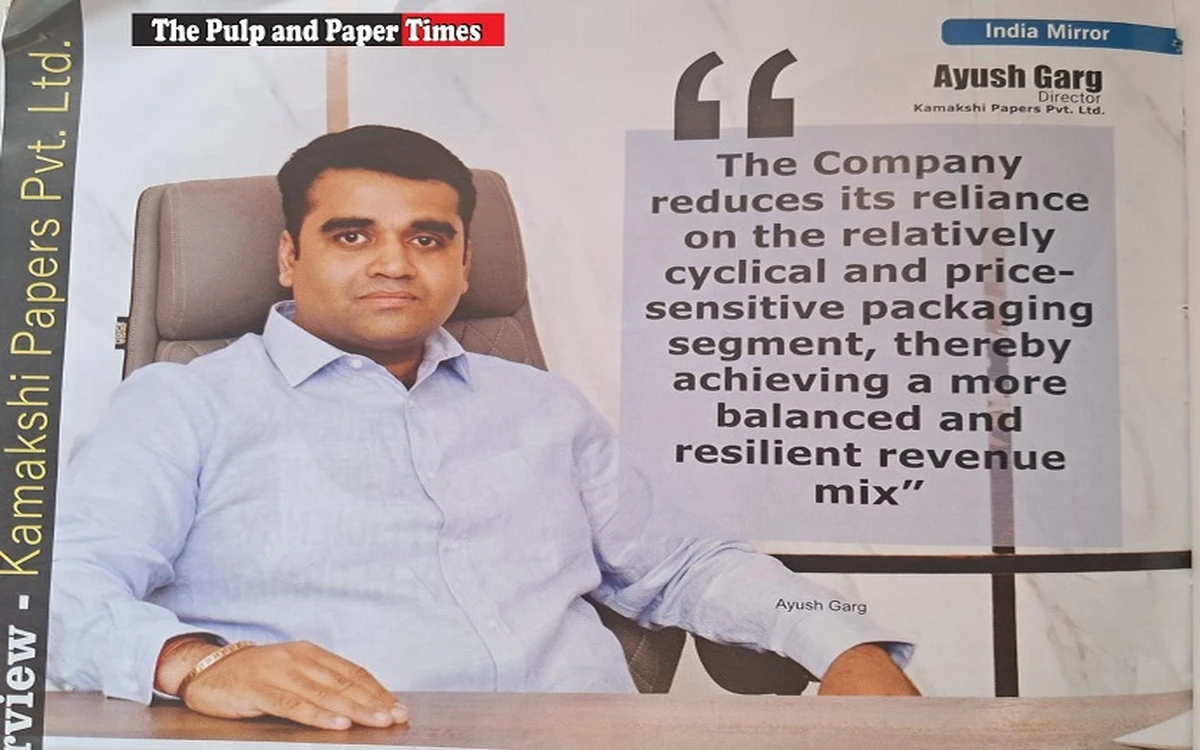
The BE and caustic soda plant marks a key milestone for Mohit Paper Mills, enabling full utilization of installed capacity and enhancing overall production efficiency
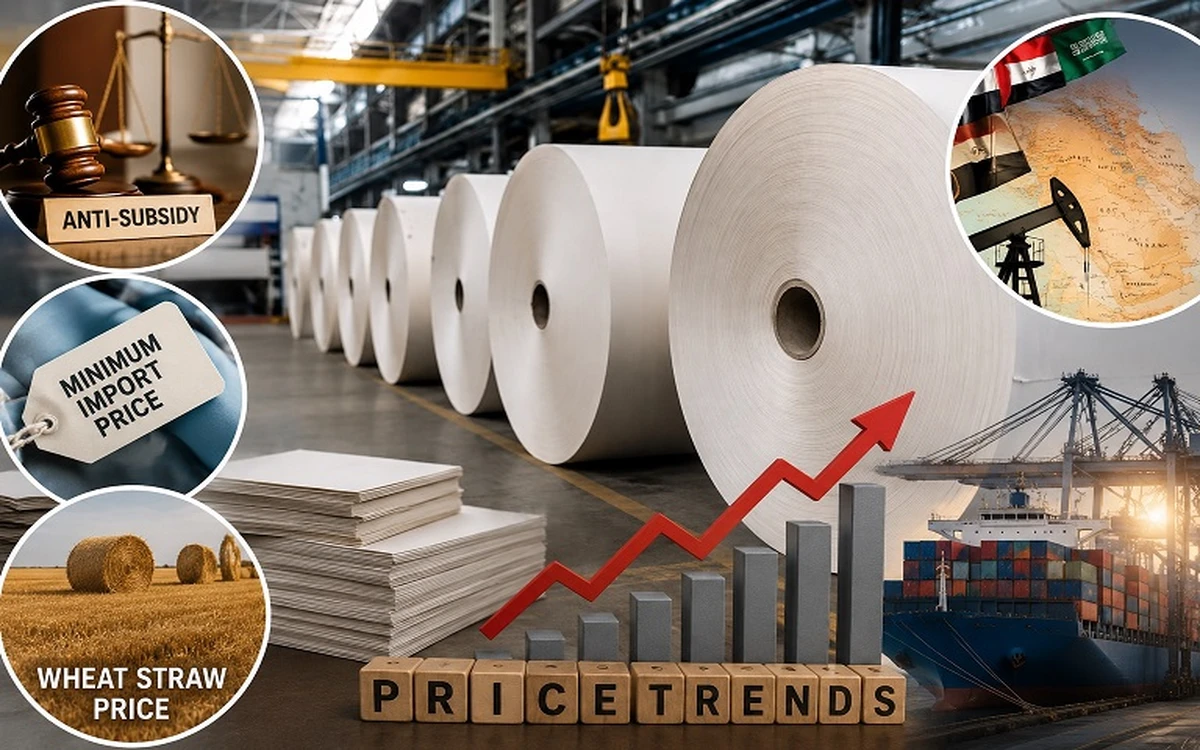
Expert Views on the paper market scenario, How the West Asia Crisis Helped the Industry, MIP for WPP, Anti-Subsidy implementation, and paper price trends
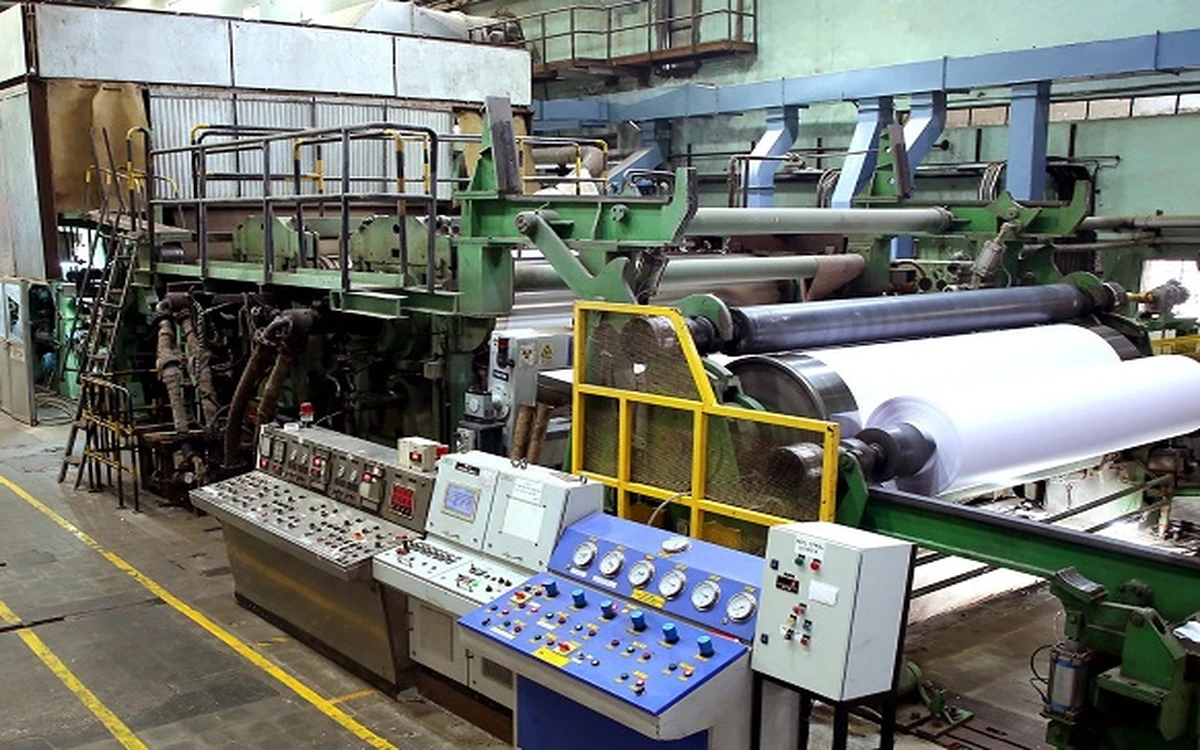
Pudumjee Paper intends to develop new varieties addressing applications for stronger paper bags and cupcakes; Plans 68,000 MT Mahad Specialty Paper Facility within 5 years
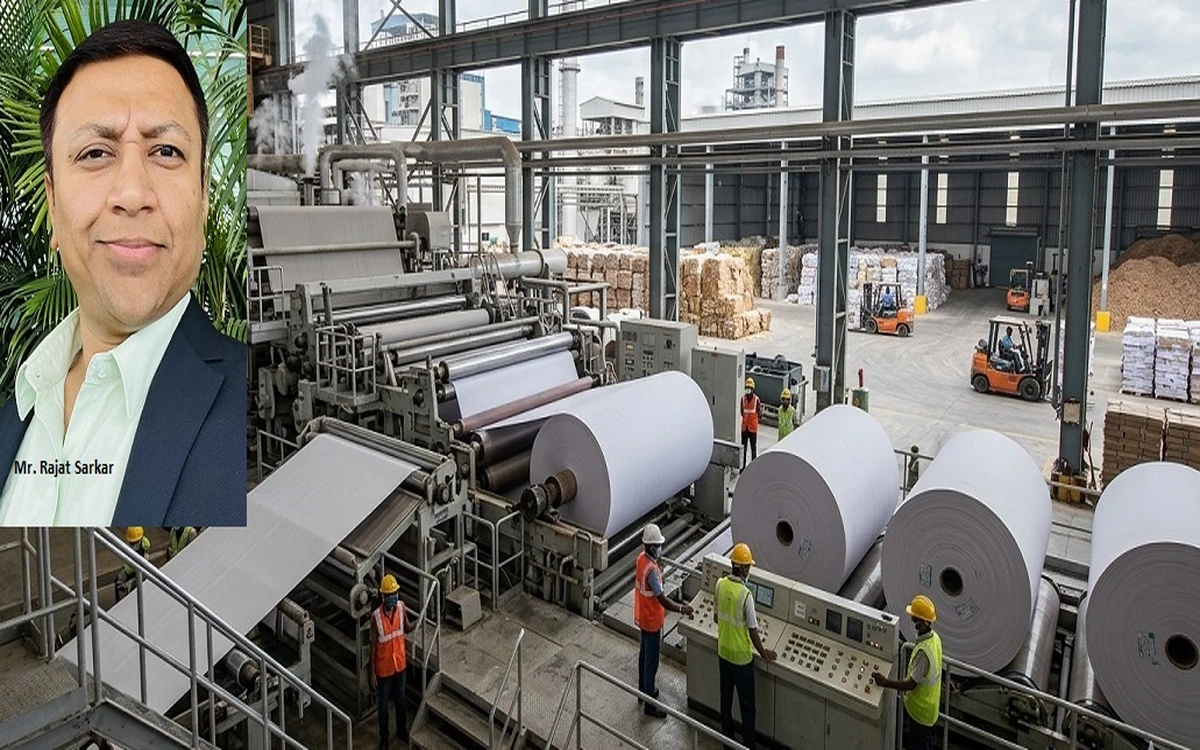
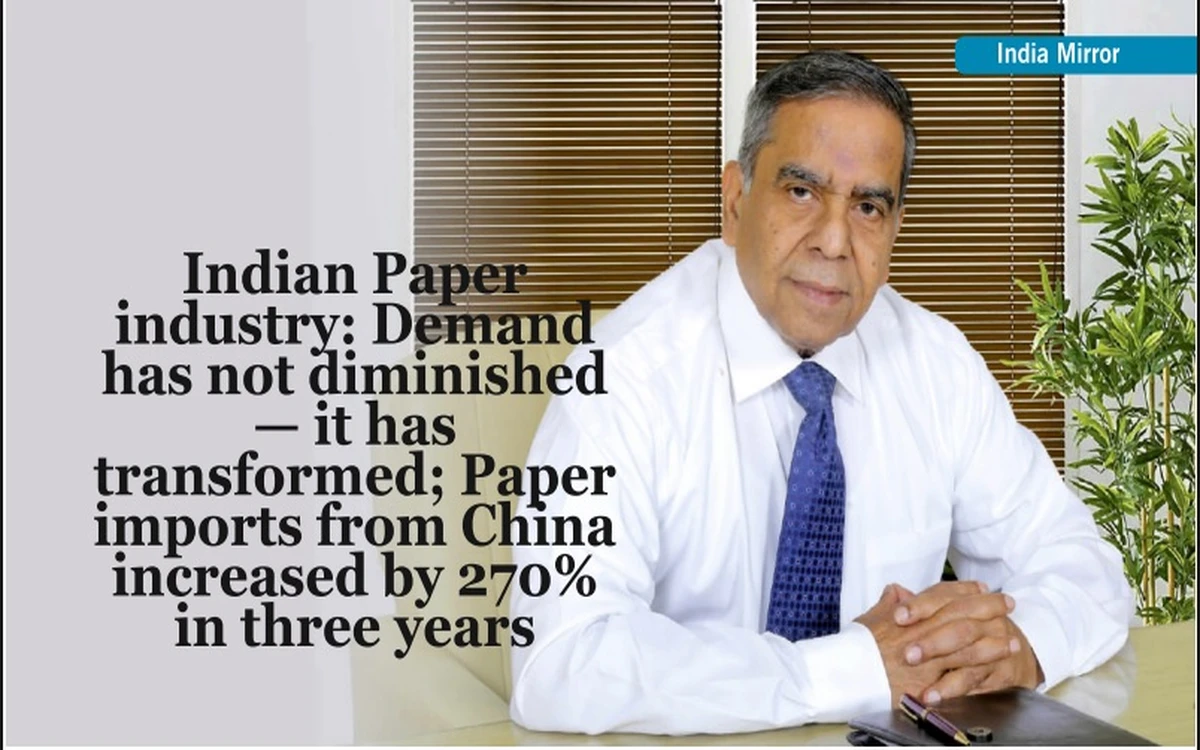
India Paper Industry at an Inflection Point: War, Costs, and Capacity; Demand growth expected at 5–7% in FY26
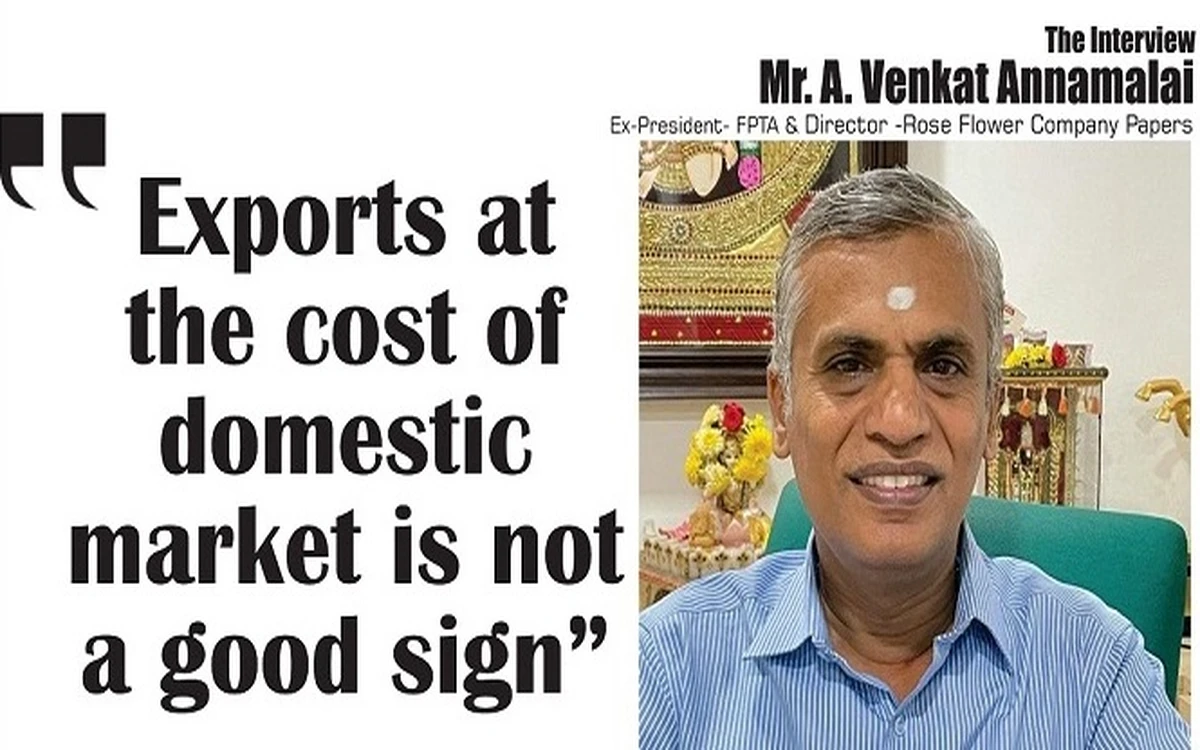
“Surging exports of paper will most certainly keep the domestic prices quite high”: Mr. A. Annamalai, Director – RFC
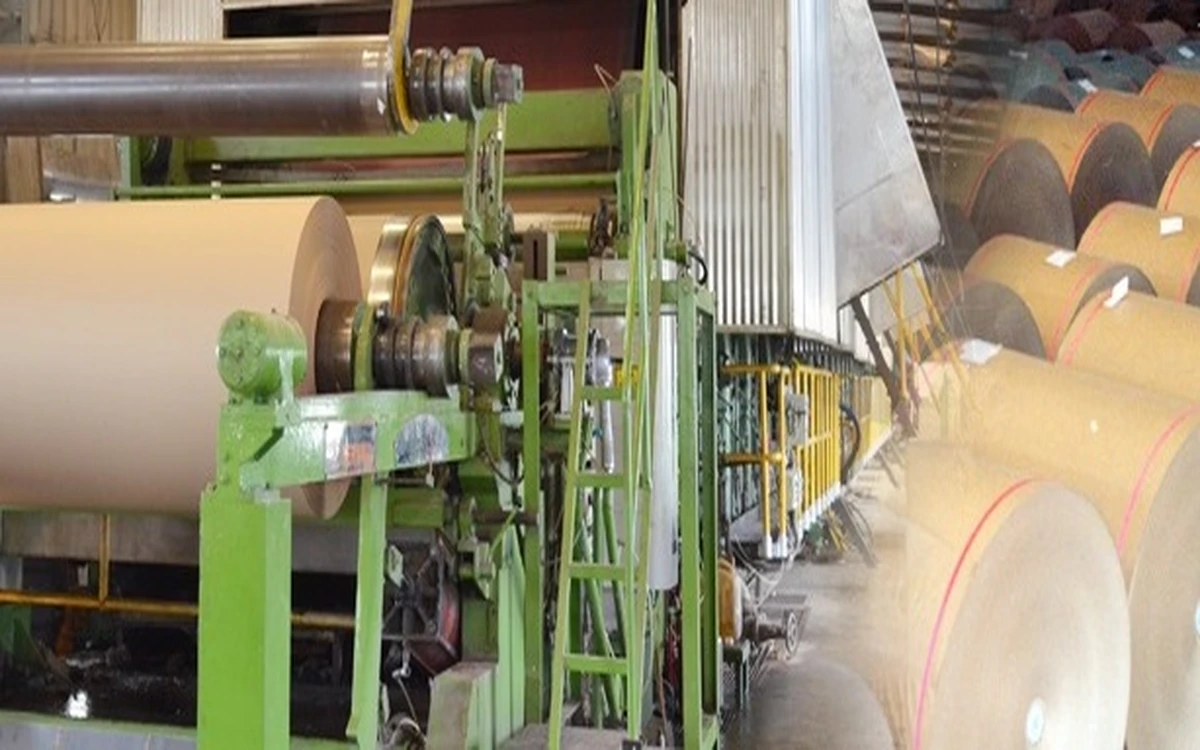
The Status of the Global Container board Industry, Recycled Paper Demand and Supply and its impact on the Indian Industry

Akshay Jain, director of Silverton Pulp & Paper, says it's time to promote agro residue as a raw material to lessen the scarcity of fibre
Advantageously located, a new paper mill is all set to roll kraft paper in Madhya Pradesh

Several agile interventions helped ITC-PSPD fortify its clear leadership of the Value Added Paperboards (VAP) segment

Steeper-than-expected drop in realisations hits Seshasayee Paper’s FY2025–26 operating margins; Box boards, Absorption Kraft, and Virgin Kraft now form a growing share of the product mix
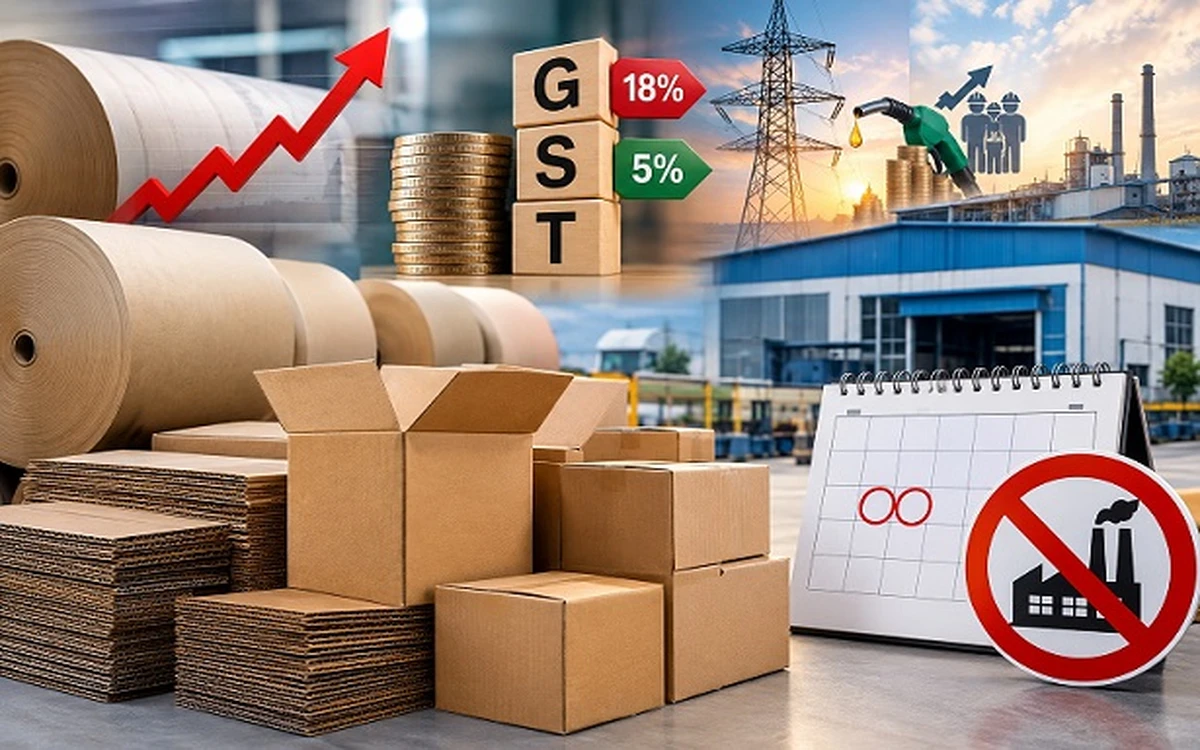
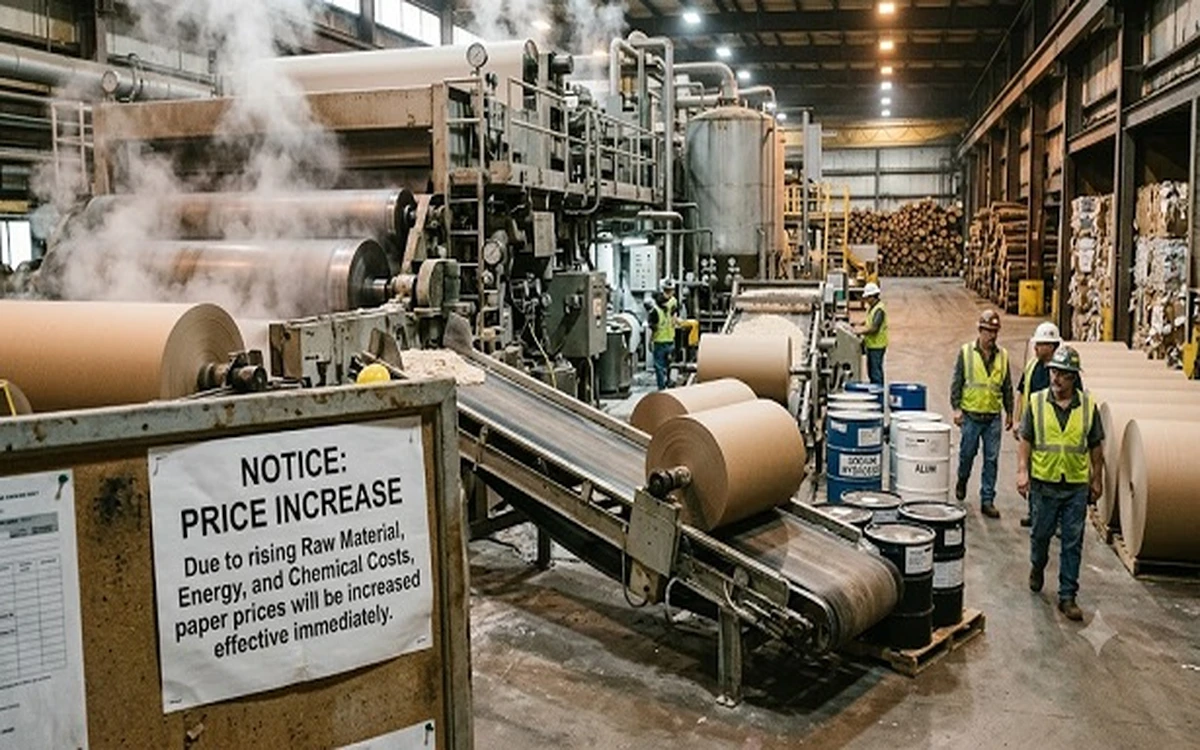
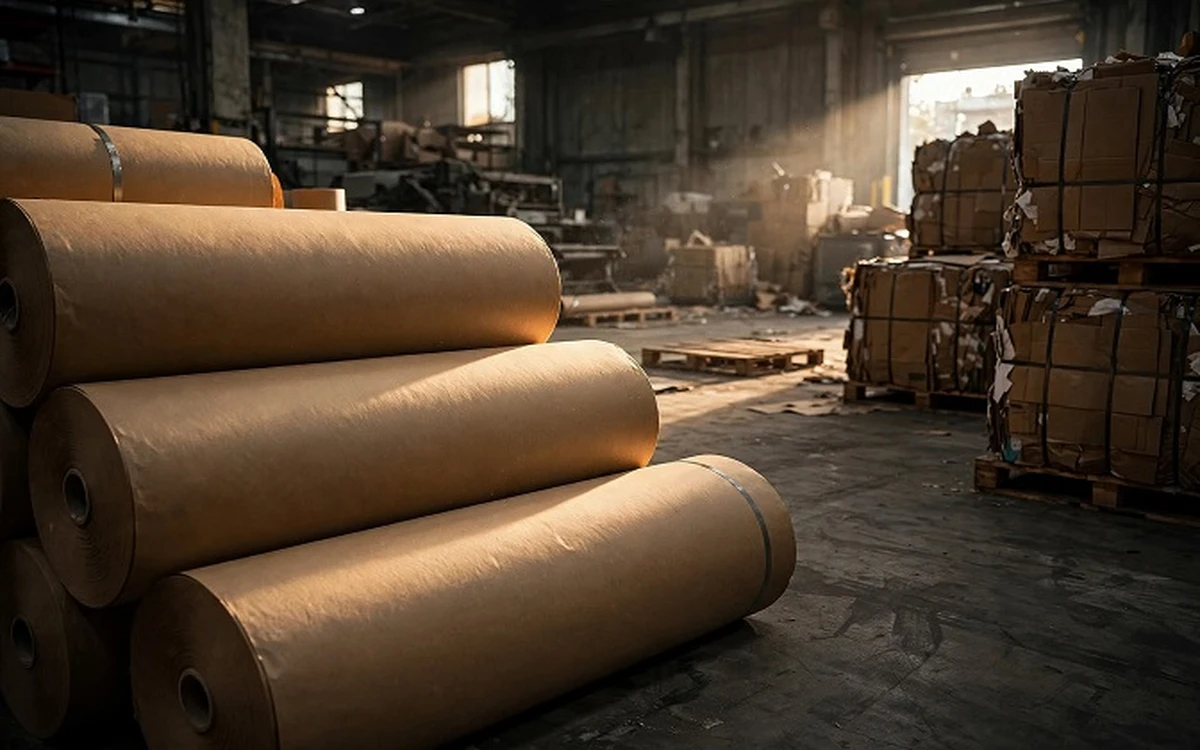
Overall Increase in Kraft Paper Prices Could Reach 35%; Industry Calls for 20% Box Price Increase, Voluntary Shutdown Proposed
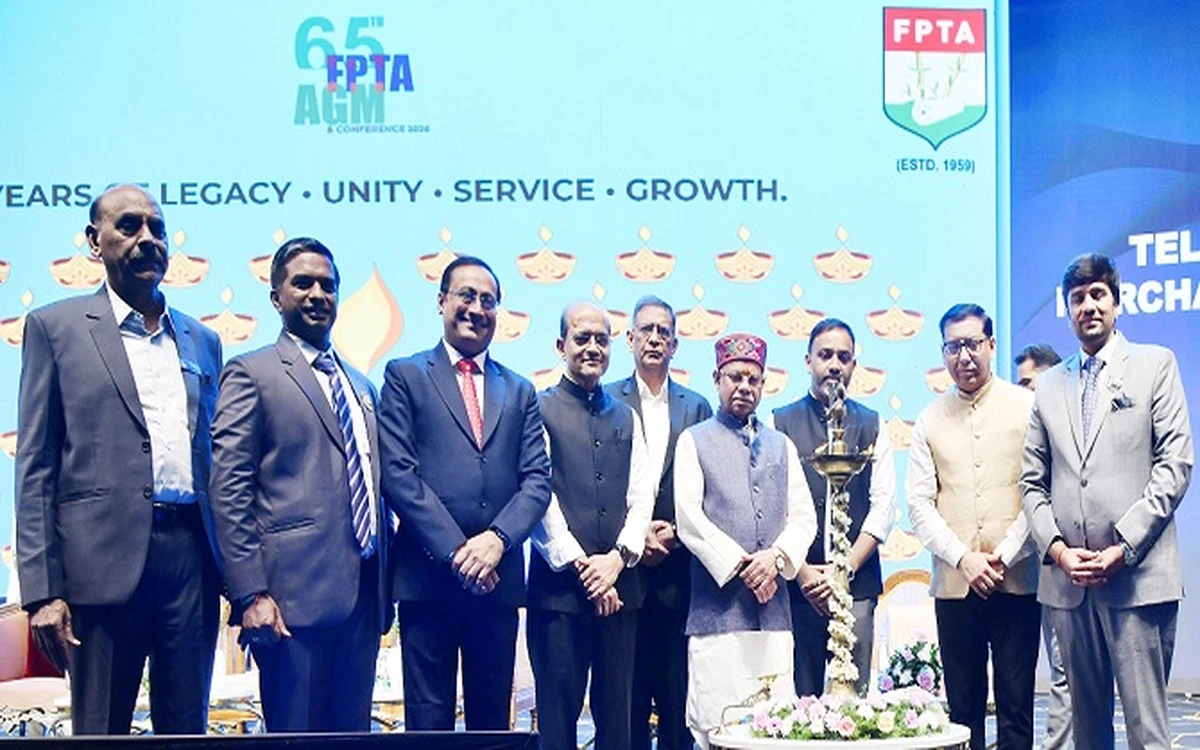
Paper Mills and Dealers Must Work Together to Create New Demand, Say Industry Leaders at FPTA’s 65th AGM

Ruchira Papers Invests a Sizeable Capex of Rs. 235–240 Crore Towards Writing & Printing Paper Capacity Expansion
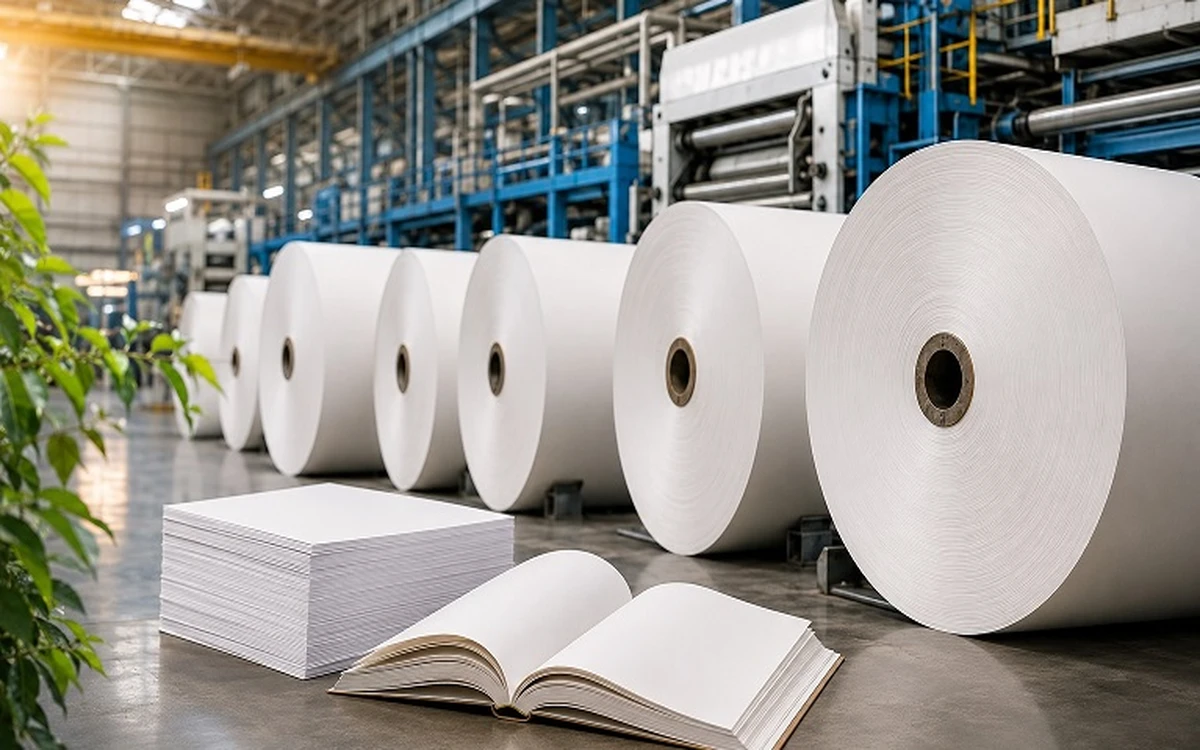
Paper mills inflated the basic ex-mill price of paper post GST 2.0, AINMA seeks action against Anti-Profiteering
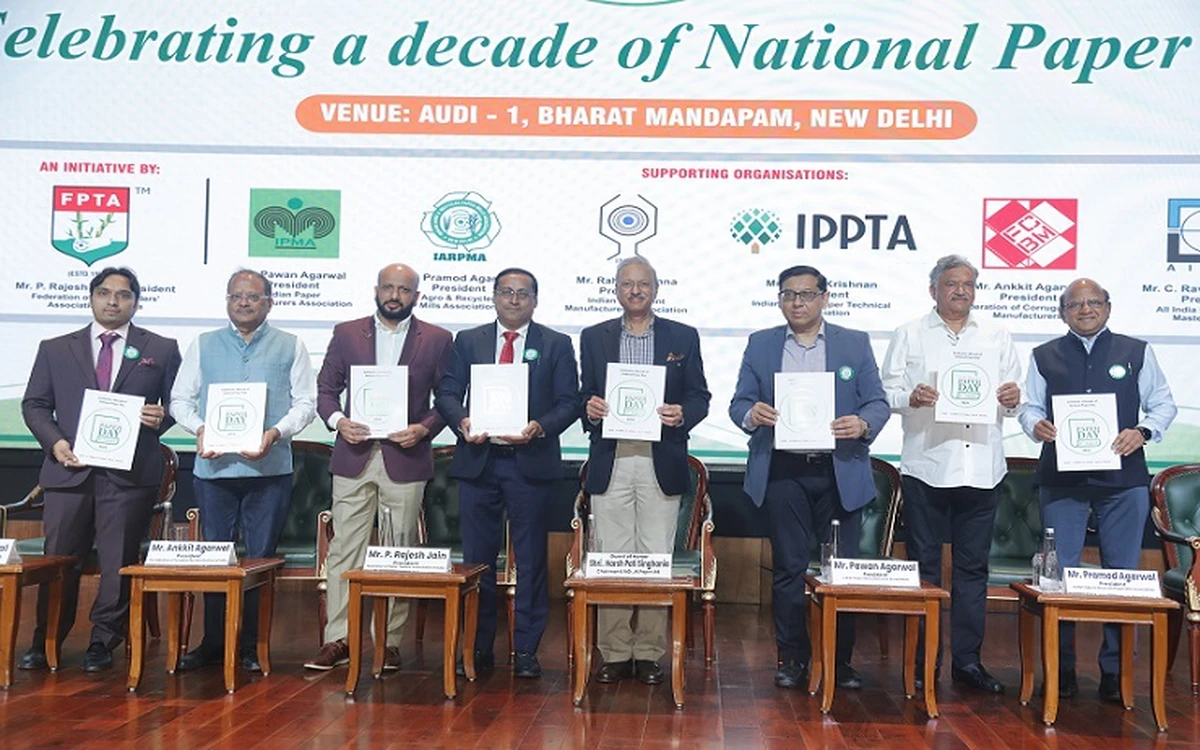
Seven Leading Associations Unite to Celebrate National Paper Day, Highlighting Paper's Sustainability and Circular Economy Advantage
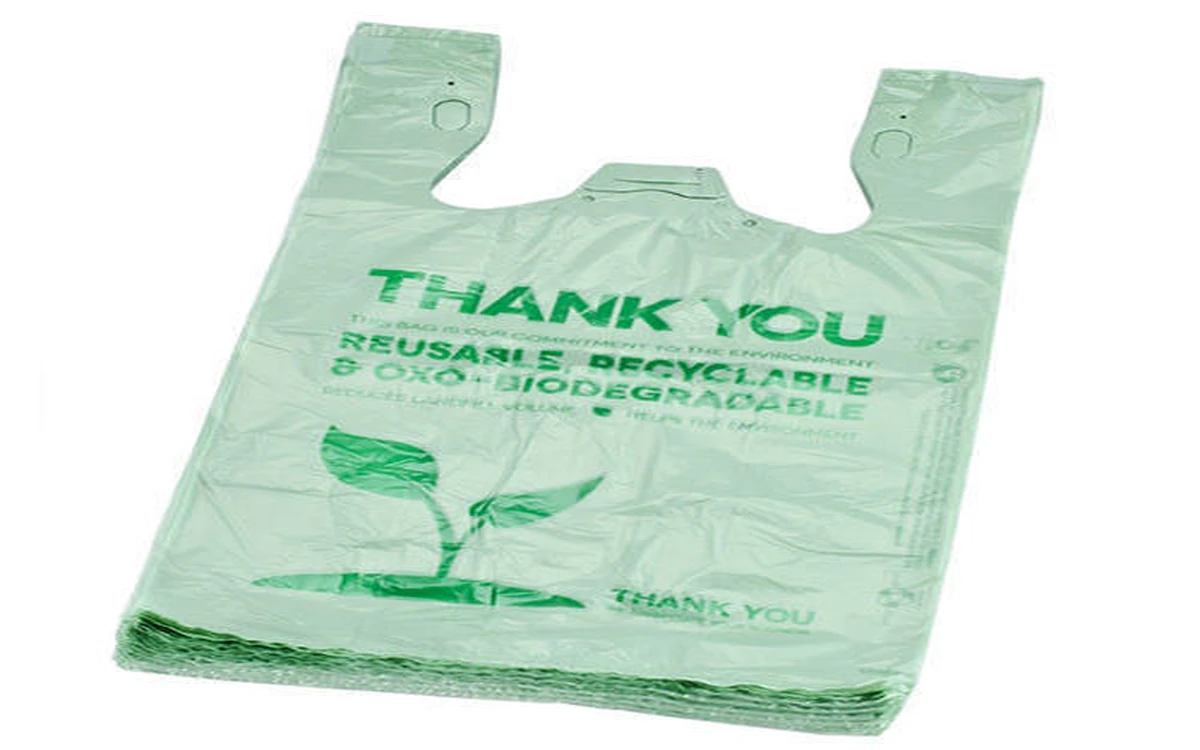
Scientists from IIT-Guwahati develop India's first biodegradable plastic
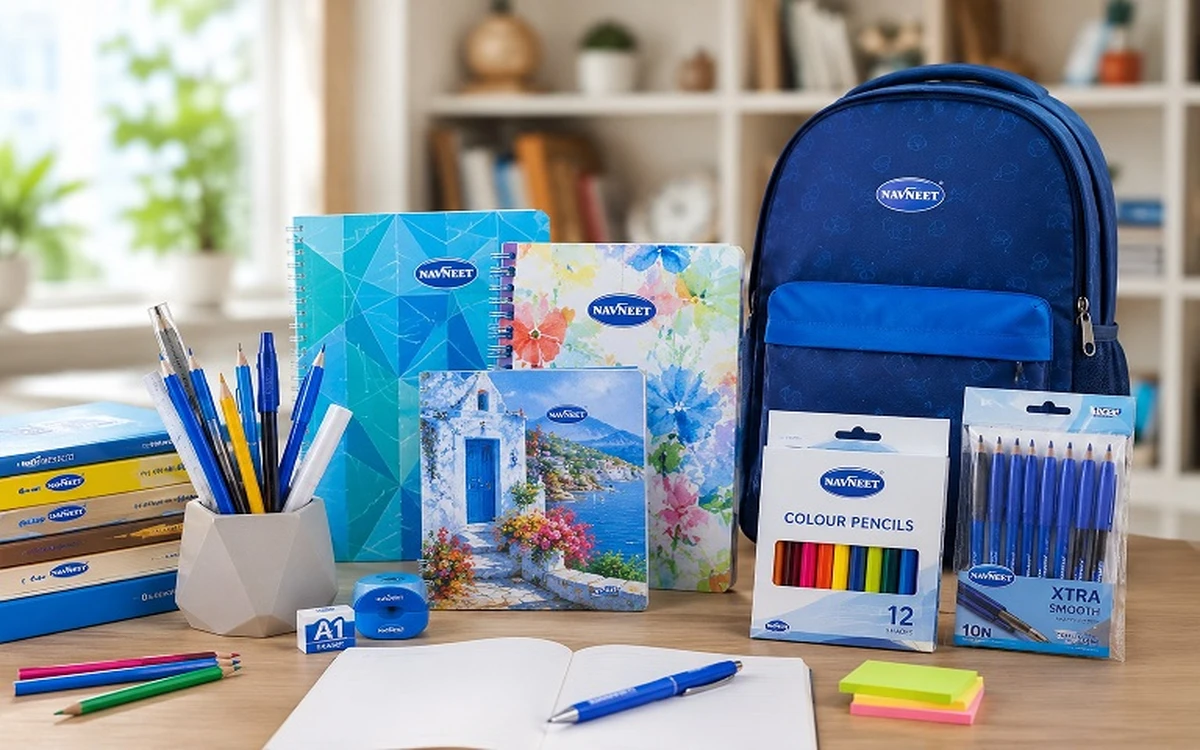
Navneet Education focuses on brand building, curriculum-led growth, and export recovery; expects stationery margins to improve in FY27

It is estimated that USD10B to USD20B worth of single-use plastic packaging will convert to molded fiber, ZUME
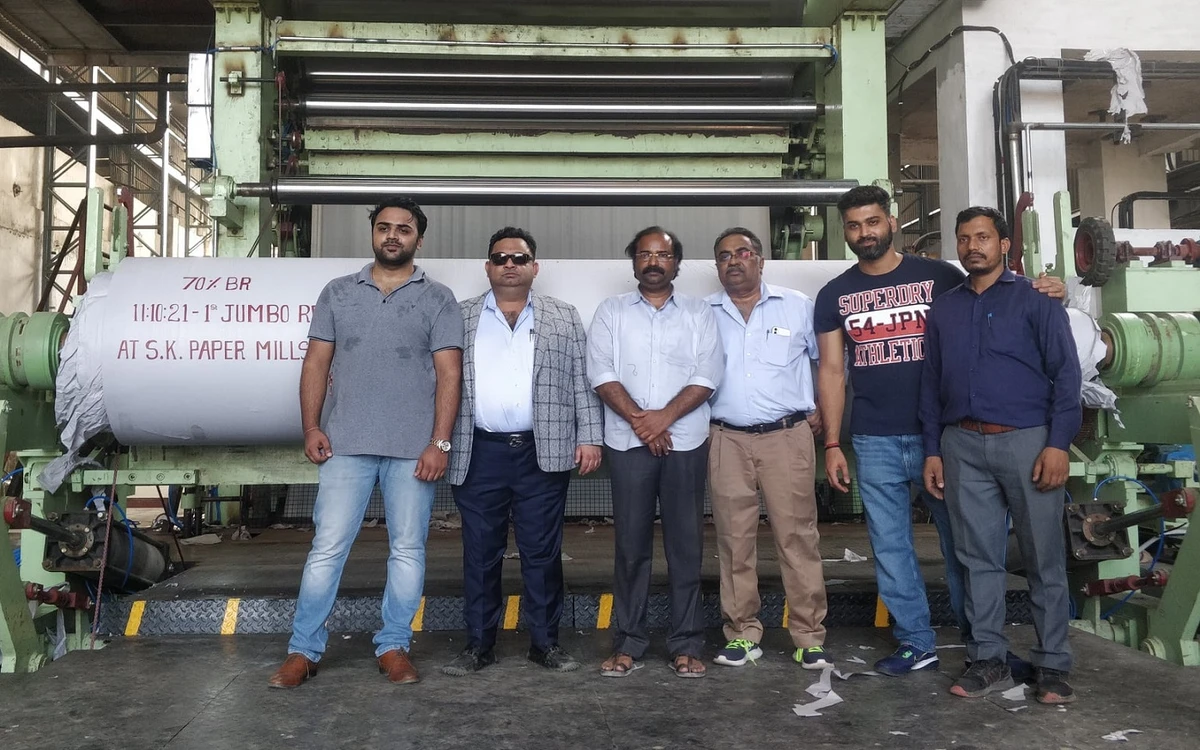
Muzaffarnagar gets a new capacity of Tissue Paper and MG Poster paper

“The integration of digitalization, automation, and Artificial Intelligence (AI) is no longer a futuristic concept—it is the baseline for competitiveness in 2036” - Vinit Garg, Director, Vizen Solutions
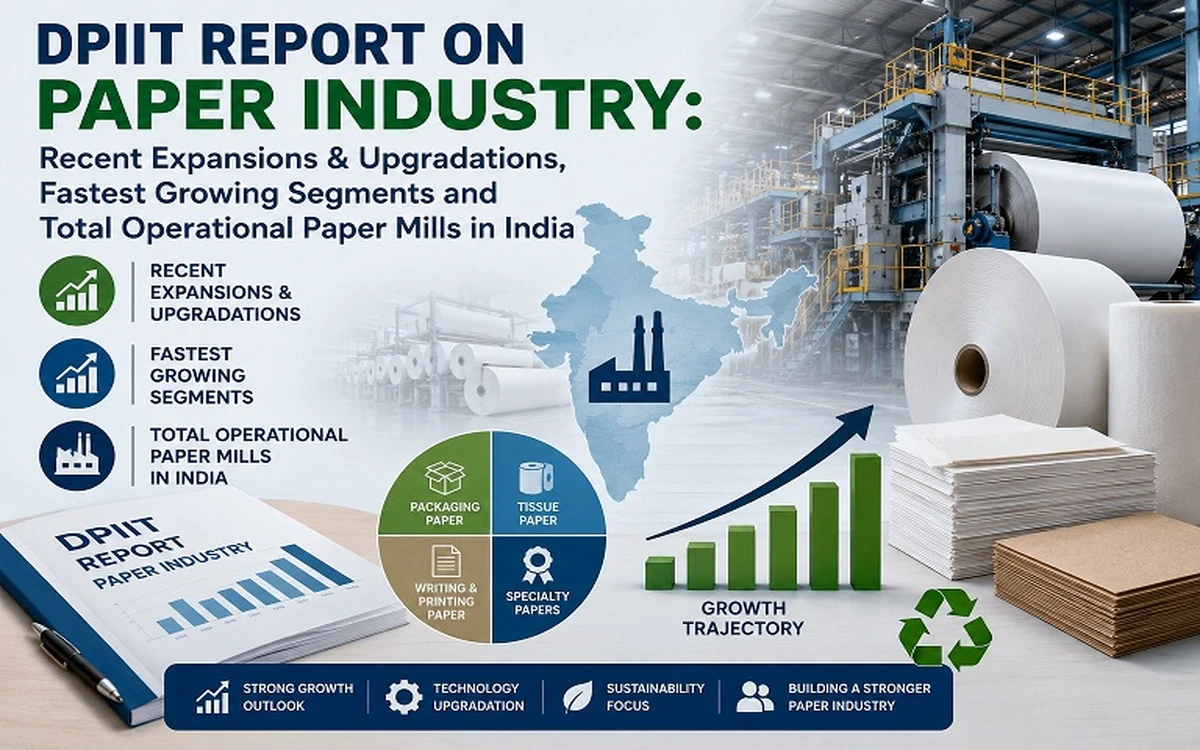
DPIIT Report on the Paper Industry: Recent Expansions & Upgrades, Fastest-Growing Segments, and Total Operational Paper Mills in India
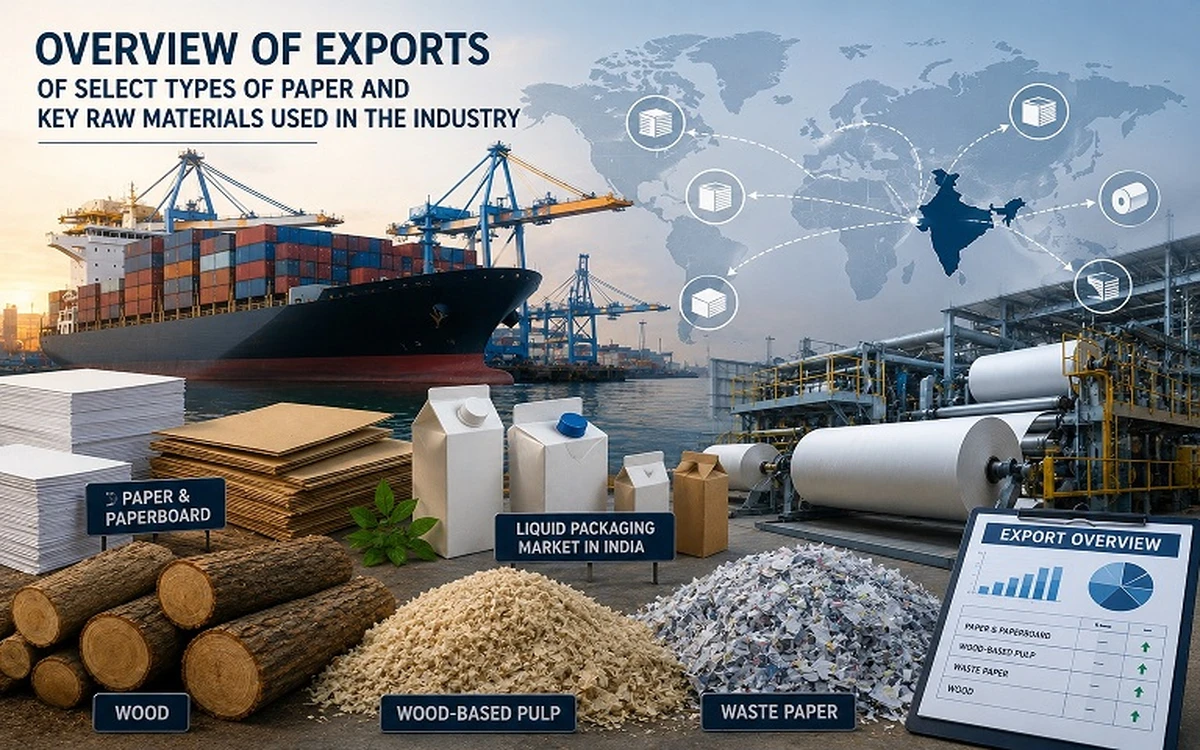
Overview of exports of select type of paper and key raw material used in the industry by Crisil Intelligence

Margin pressure pushes Pulp & Paper Packaging sector toward AI-Driven cost optimization, Cutting costs by 8–20%
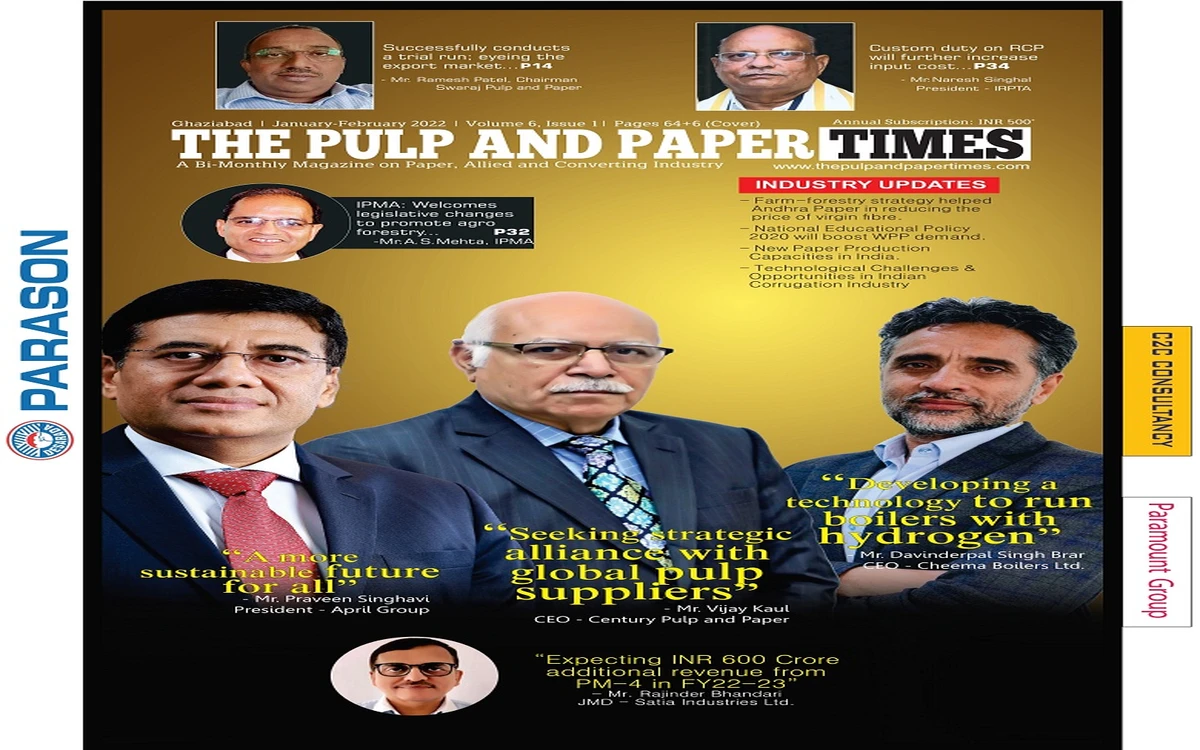
The Pulp and Paper Times Magazine : Volume 6, Issue 1

The Pulp and Paper Times Magazine : Volume 5, Issue 6
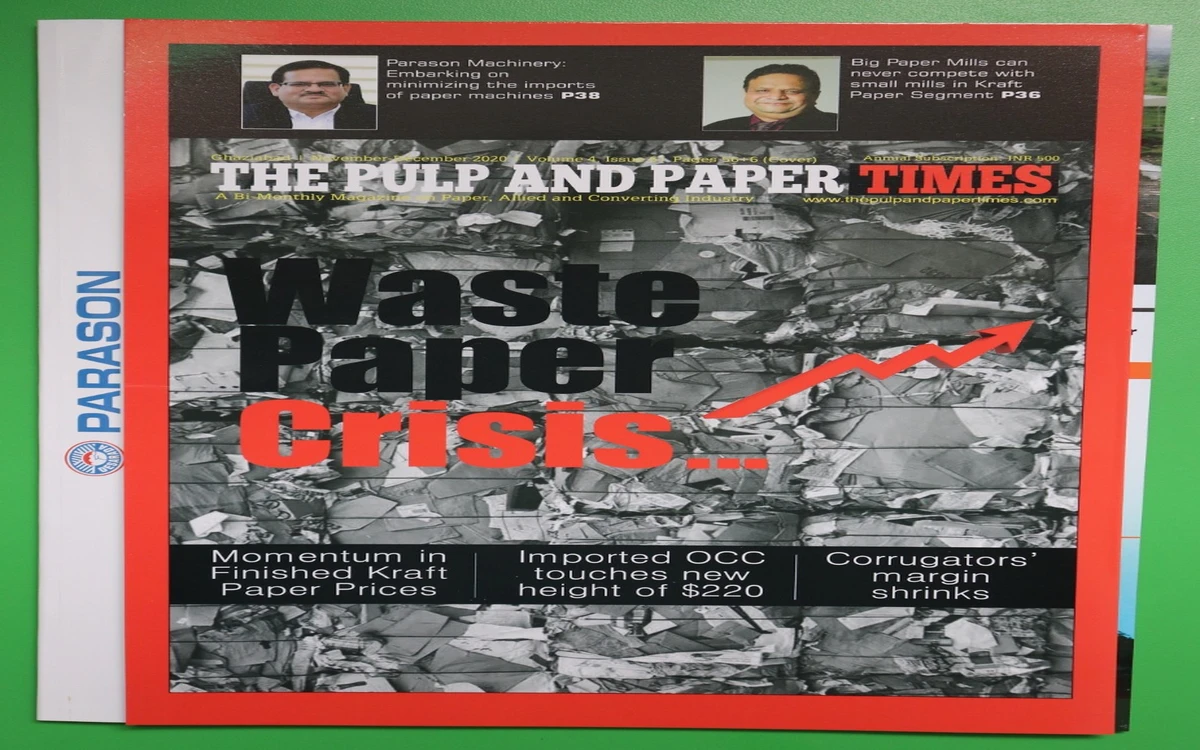
The Pulp and Paper Times: Volume 4, Issue 6
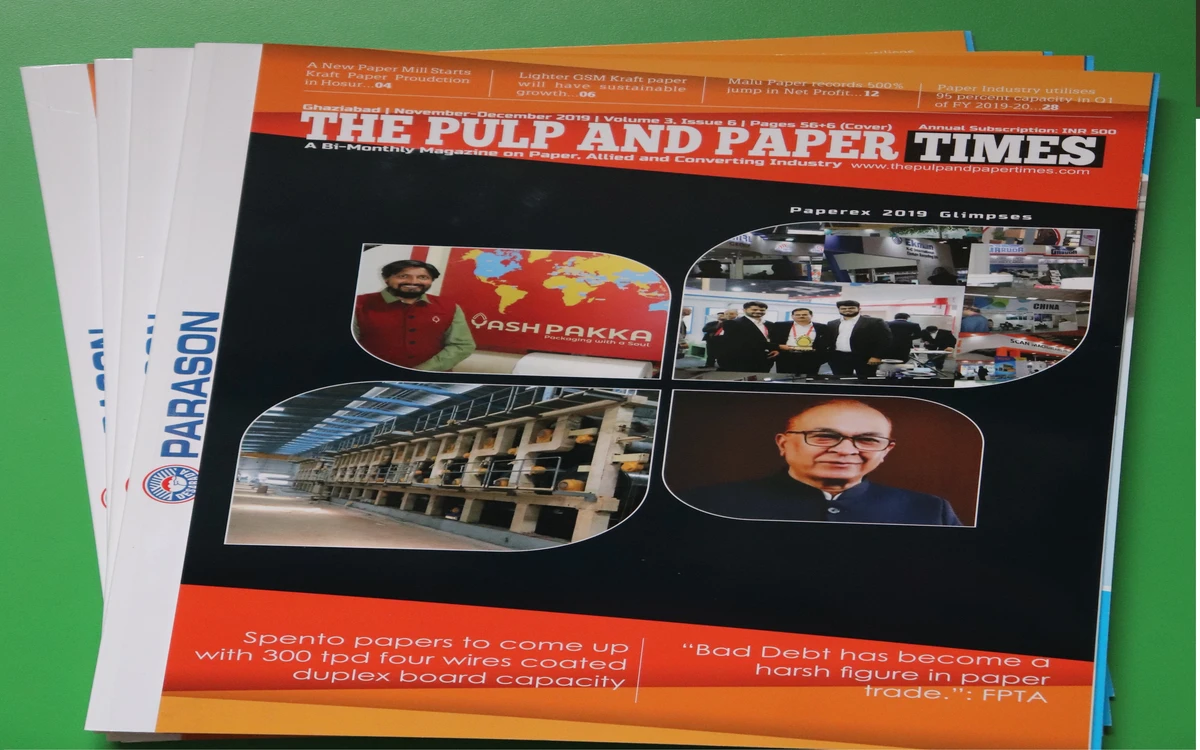
The Pulp and Paper Times : Volume 3, Issue 6
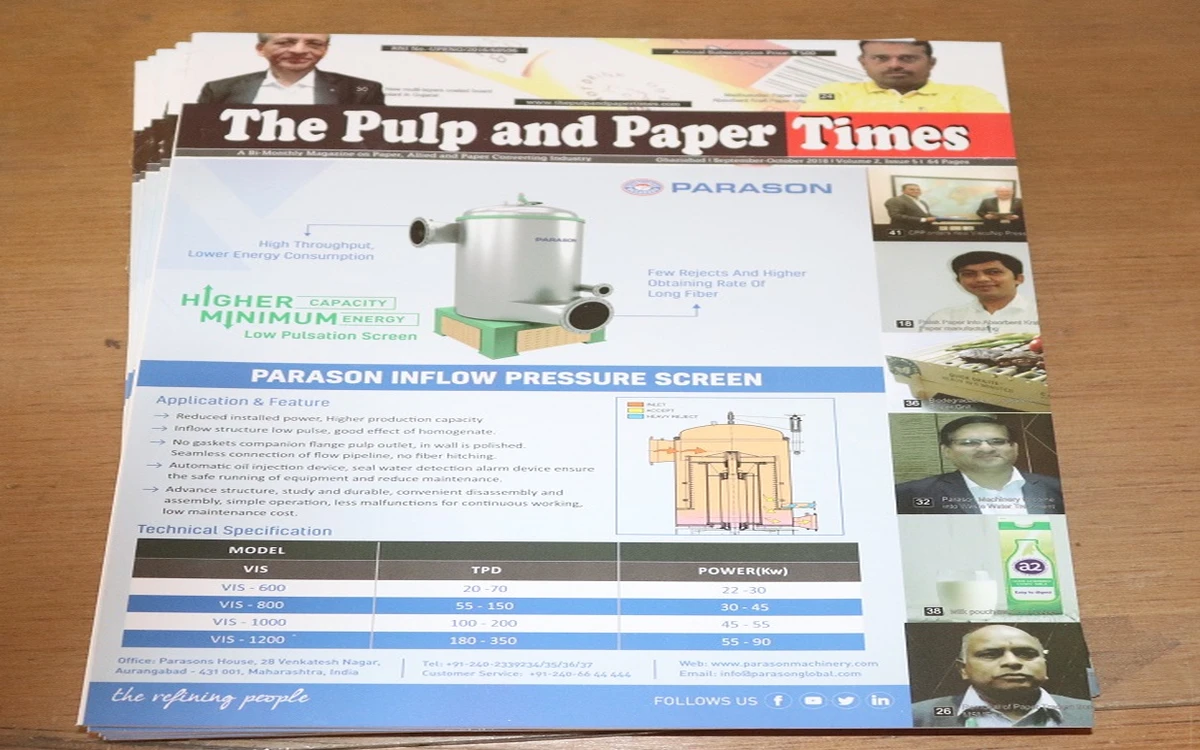
The Pulp and Paper Times: Volume 2 Issue 5

The Pulp and Paper Times, Volume 1, Issue 3
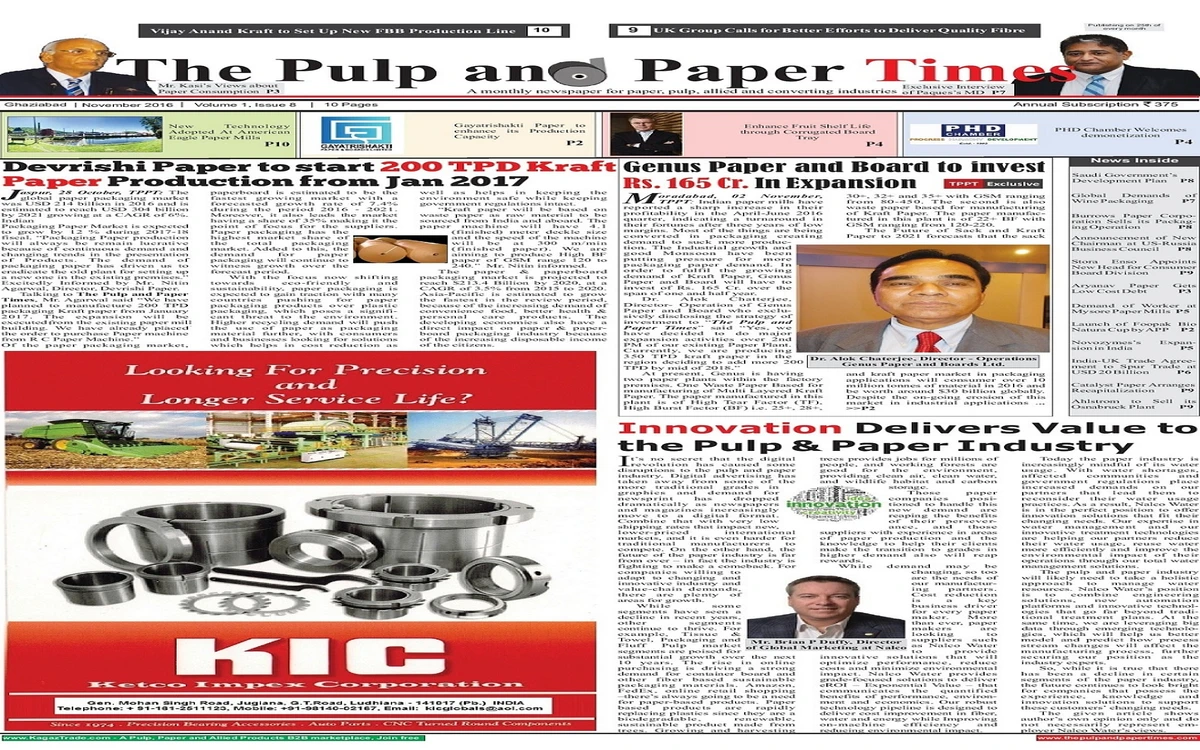
The Pulp and Paper Times, November 2016 Issue
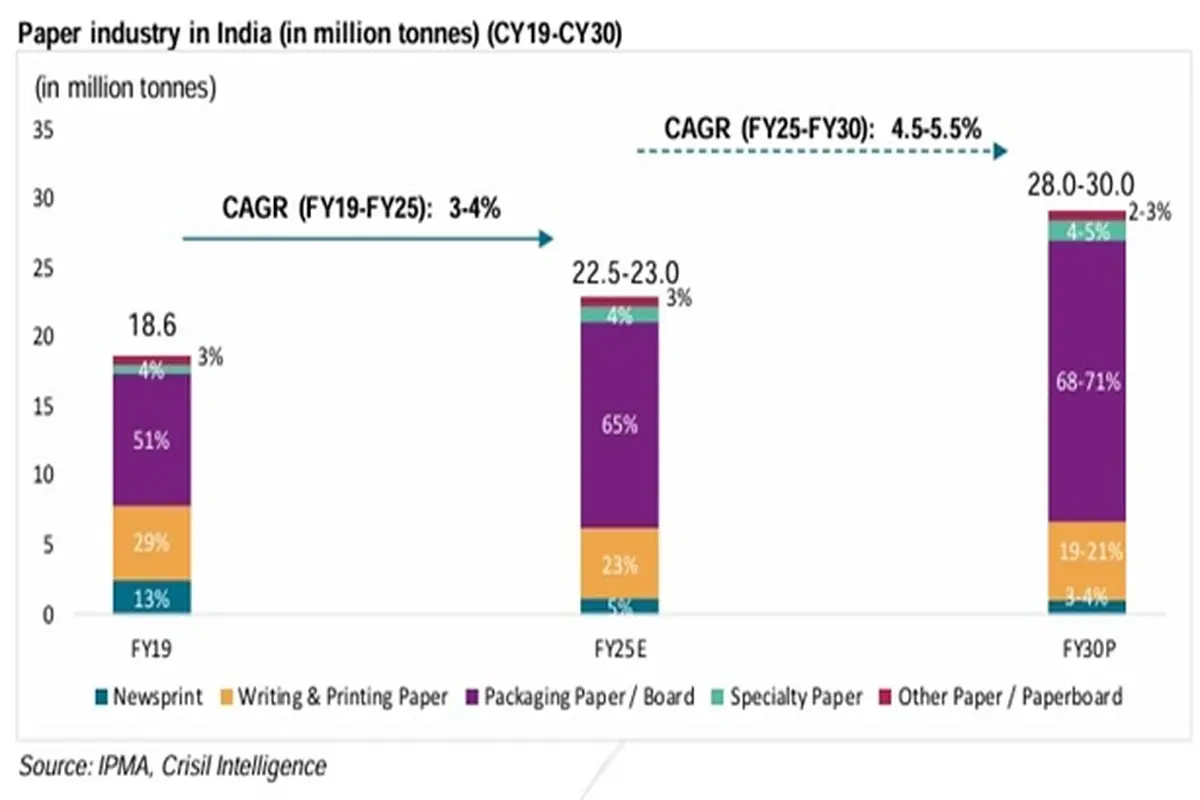
Indian paper industry expected to grow at 4.5-5.5% CAGR to reach 28.0-30.0 million tonnes in volume by FY30
The Pulp and Paper Times
The Indian paper industry has grown from 18.6 million tonnes in FY19 to 22.5-23.0 million tonnes in FY25. During this period, it has grown at a CAGR of 3-4%, with the paperboard segment being the main contributor to this growth fuelled by increasing demand from E-commerce, food and beverage industries, as well as the need for sustainable packaging solutions. In addition to this, growth can be attributed to India's growing economy, rising consumer spending, and government initiatives promoting paper and paper products such as the ban on single-use-plastics. From FY25 to FY30, the Indian paper industry is expected to grow at a CAGR of 4.5-5.5% and thereby reach a size of 28.0 -30.0 million tonnes in FY30. Demand will be led by healthy growth in paperboard volume, which is expected to clock 6-8% CAGR over FY25 to FY30. This growth would be driven by increased volumes in end-user segments such as household appliances, fast-moving consumer goods (FMCG), ready-made garments, pharmaceuticals, e-commerce, etc. W&P demand is expected to increase at a modest 1-3% CAGR over FY25 to FY30. Specialty paper is expected to log a 6-8% CAGR over FY25 to FY30. All in all, the packaging paper / board segment is expected to see its share rise from 65% in FY25 to 68-71% in FY30. While Newsprint and writing and printing paper is expected to see its share diminish from 5% to 3-4% and 23% to 19-21% respectively during the same period.

Writing and Printing (W&P) paper:
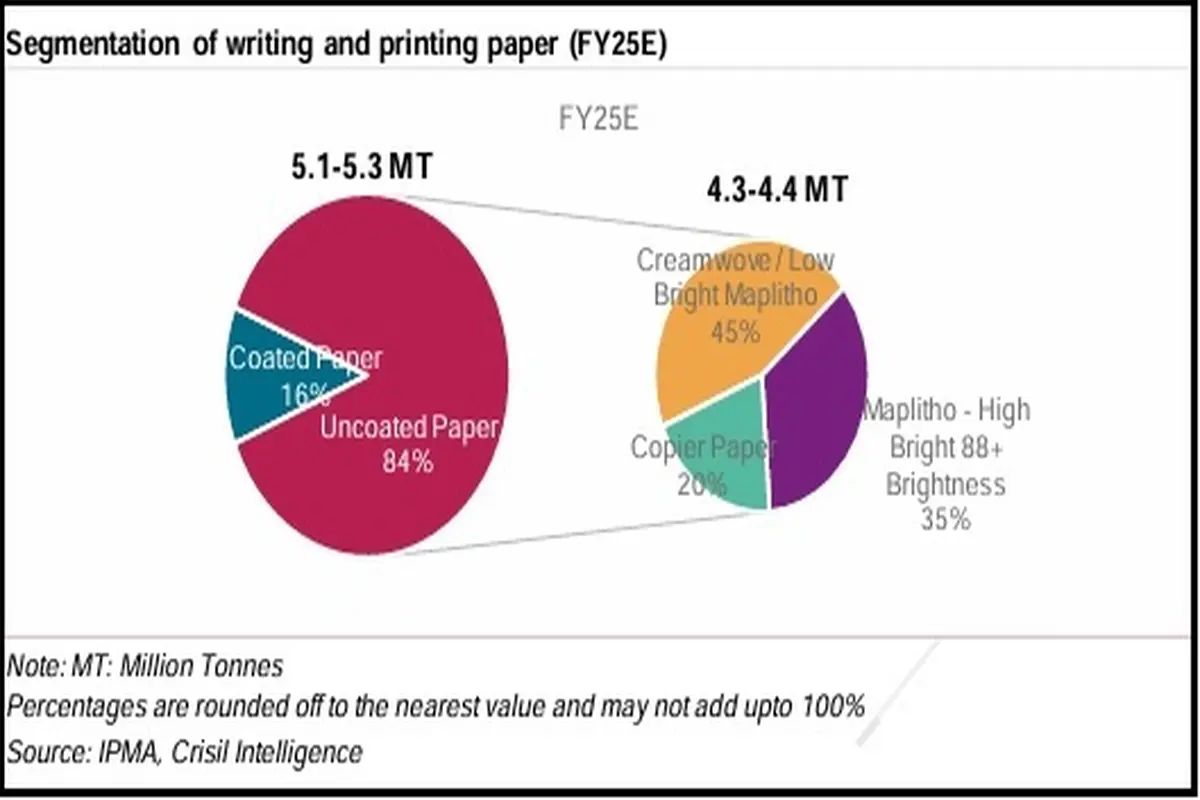
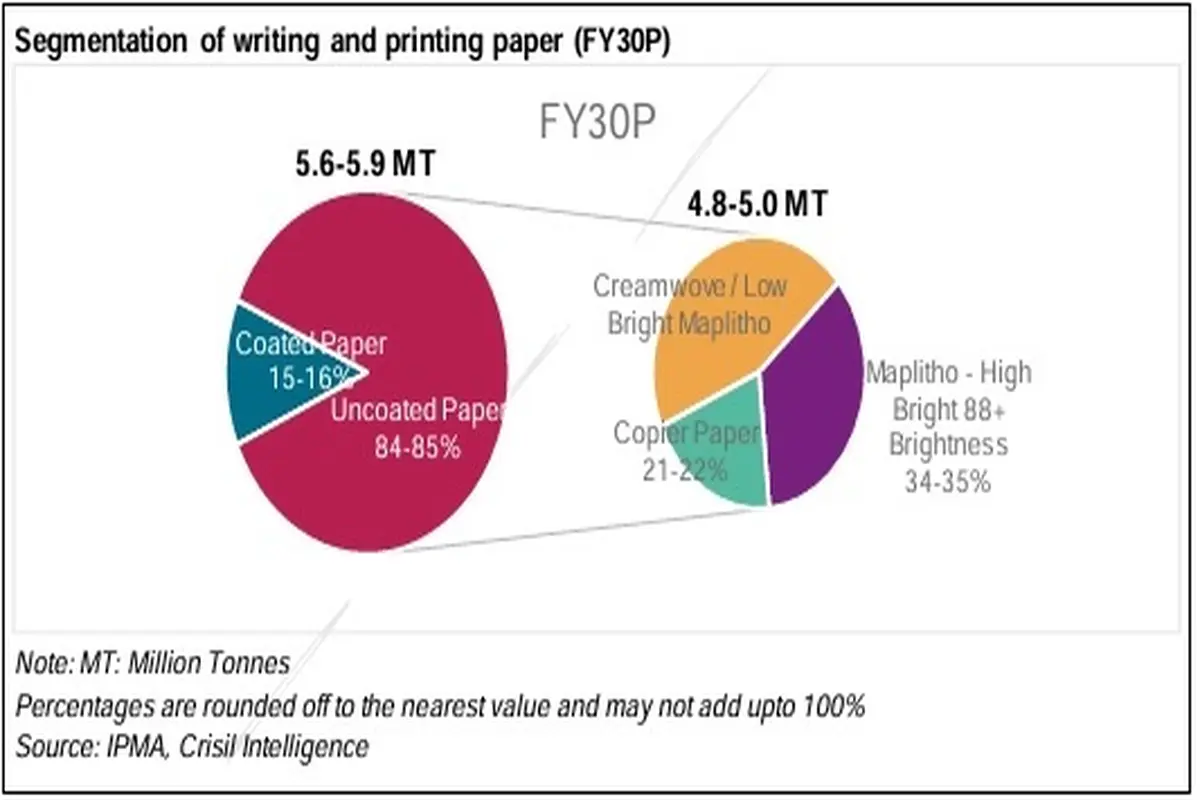
Uncoated paper expected to maintain its estimated share of 84% in volume terms in the W&P segment till FY30
In the Writing and Printing segment, uncoated paper dominated the market with an estimated share of 84% in FY25, while coated paper accounted for the remaining 16%. Looking ahead, the share of both types of W&P paper is expected to remain relatively stable at 84-85% and 15-16% respectively, although uncoated paper is anticipated to grow at a faster pace due to increasing demand from the education and office supplies sectors, as well as its relatively lower cost compared to coated paper.
Within the uncoated paper segment, Creamwove/low bright maplitho held a significant share of 45% in terms of volume in FY25. However, its share is expected to decline marginally to 44-45% in FY30 due to the decreased use in business stationery including letterheads, envelops etc. Maplitho paper with high brightness (88+ brightness) saw its share decrease from 35% in FY25 to 34-35% in FY30, largely attributed to the rising competition from digital media and the subsequent decline in demand for high-end printing papers. Having said that, with new education policy coming to effect and a gradual rise in education spend by the government (~20% higher spend between fiscals 2020 and 2023 compared with the previous three fiscals) and increased thrust on education (through initiatives such as Sarva Shiksha Abhiyaan/Education for All) are likely to support demand for creamwove and maplitho paper.

On the other hand, copier paper is expected to experience a slight increase in its share, rising from 20% in FY25 to 21-22% in FY30, driven by the ongoing demand for everyday printing and copying needs in educational institutions.
Packaging paper / board:
Packaging paper / board segment expected to grow from 14.7-15.1 MT in FY25 to 20.1 20.6 MT in FY30
The packaging paper/board segment, which grew at a CAGR of ~8% from FY19 to FY25, is expected to grow at a CAGR of ~6-7% from FY25 to FY30 on the back of growth in the paperboard sub-segment, which is expected to see its share in the packaging paper/board segment rise from 42% in FY25 to 42-44% in FY30. This growth is driven by increasing demand for premium and sustainable packaging solutions, particularly in the e-commerce and food packaging industries, where paperboard is preferred for its durability, printability, and eco-friendliness.

Meanwhile, the kraft paper/board sub-segment, though expected to see its share decrease from ~58% in FY25 to 56-58% in FY30, is expected to see growth in volume of ~5-7% from 8.6-8.6 MT in FY25 to 11.4-11.8 MT in FY30. The growth is being led by flexible packaging used in the E-commerce industry and the usage of sustainable packaging solutions, such as biodegradable and compostable packaging.
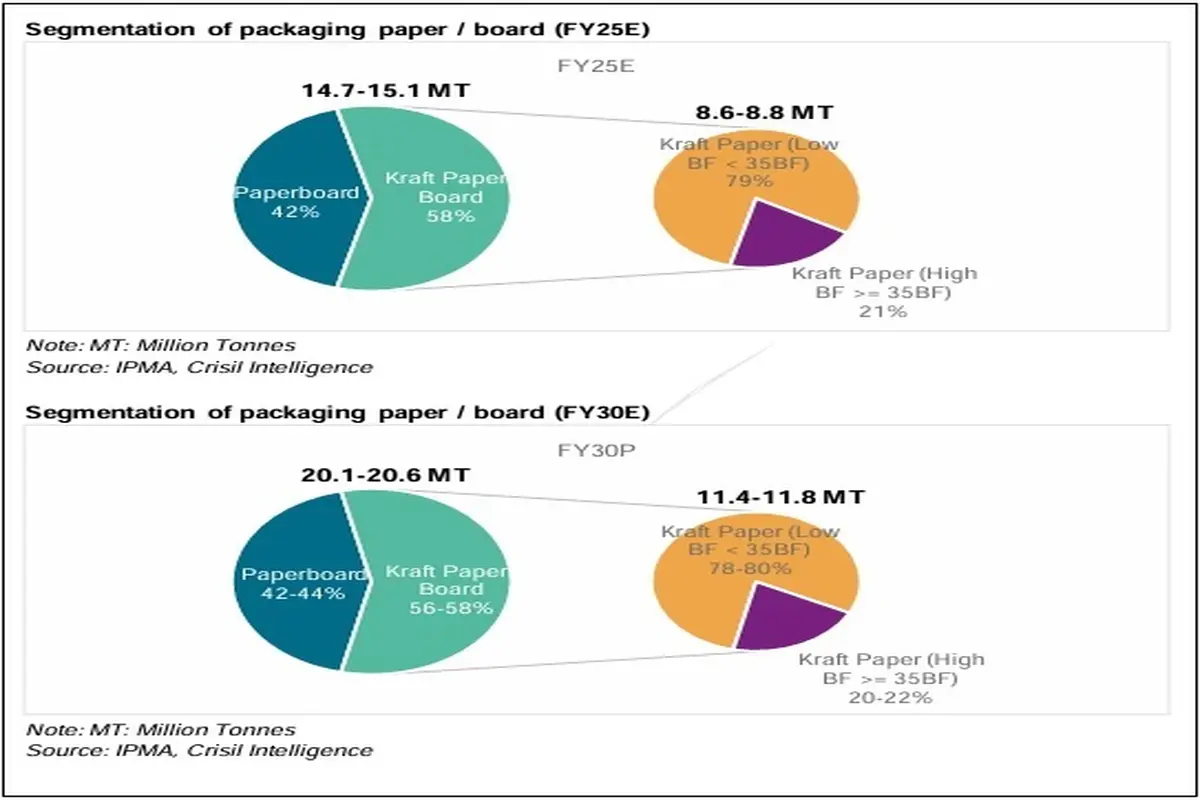
Low BF(<35) Kraft paper estimated to have a share of 79% in the kraft paper sub segment in FY25
The Kraft paper sub-segment is estimated to have been dominated by low Bursting Factor (BF) (<35BF) Kraft paper at 79% in FY25, which is primarily used for applications such as packaging, wrapping, and bagging of products like food, groceries, and other consumer goods. Low BF Kraft paper is preferred for these applications due to its good printability and affordability, making it an ideal material for packaging products that require a balance of cost and performance. On the other hand, High Bursting Factor (>=35BF) Kraft paper had an estimated share of 21% in FY25 and is typically used for more demanding applications such as heavy-duty packaging. industrial packaging, and shipping sacks, where its higher bursting strength provides improved resistance to punctures and tears.

Going forward, the share of both the sub segments of kraft paper is expected to remain more or less same with the Low BF kraft paper expected to have a share of 78-80% in FY30 while the high BF kraft paper is expected to have a share of 20-22% in FY30.
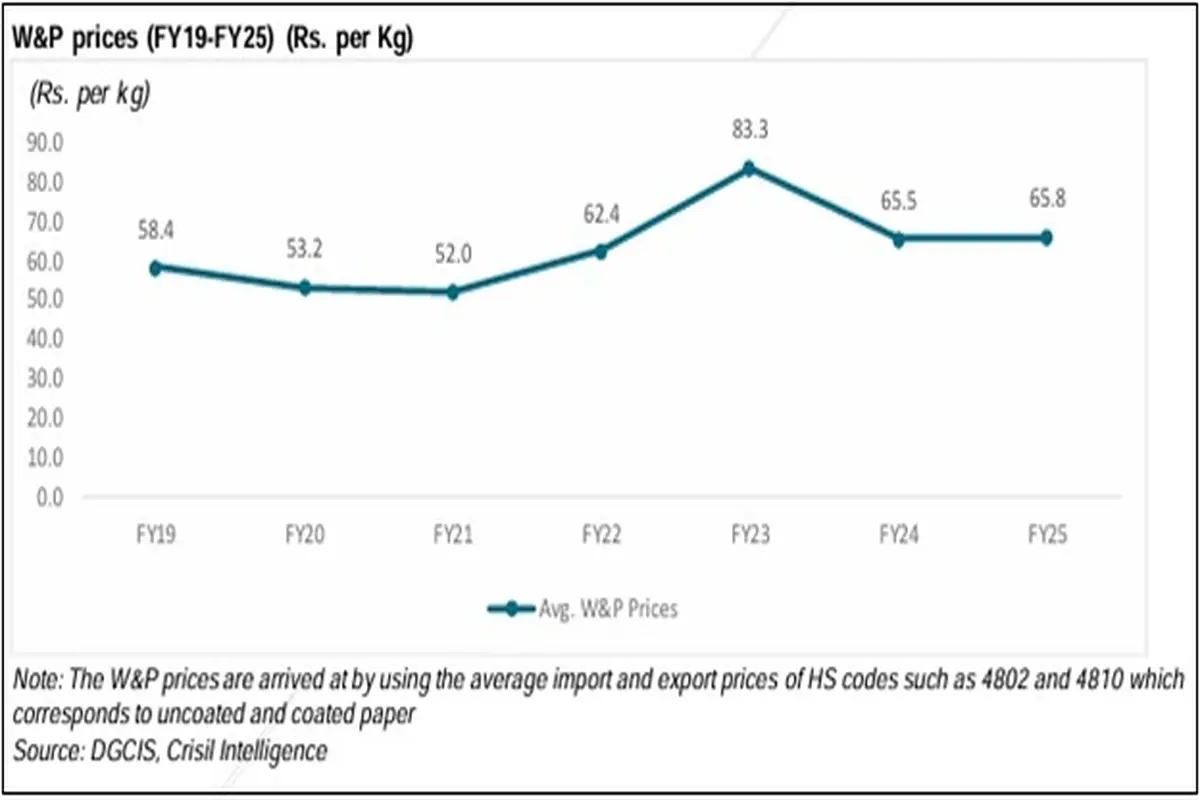
Domestic W&P average prices grew from Rs. 58.4 per kg in FY19 to Rs. 65.8 per kg in FY25
Domestic W&P prices (average price of import and export prices of coated and uncoated paper) are estimated to have corrected by -21% on-year in fiscal 2024 from the highs of fiscal 2023 in movement with the falling trend of pulp prices. The excess supply in the market amidst tepid demand is likely to keep prices in moderation for fiscal 2025. Overall, the W&P prices have grown from Rs. 58.4 per kg in FY19 to Rs. 65.8 per kg in FY25 growing at a CAGR of 2% from FY19 to FY25.

Specialty paper:
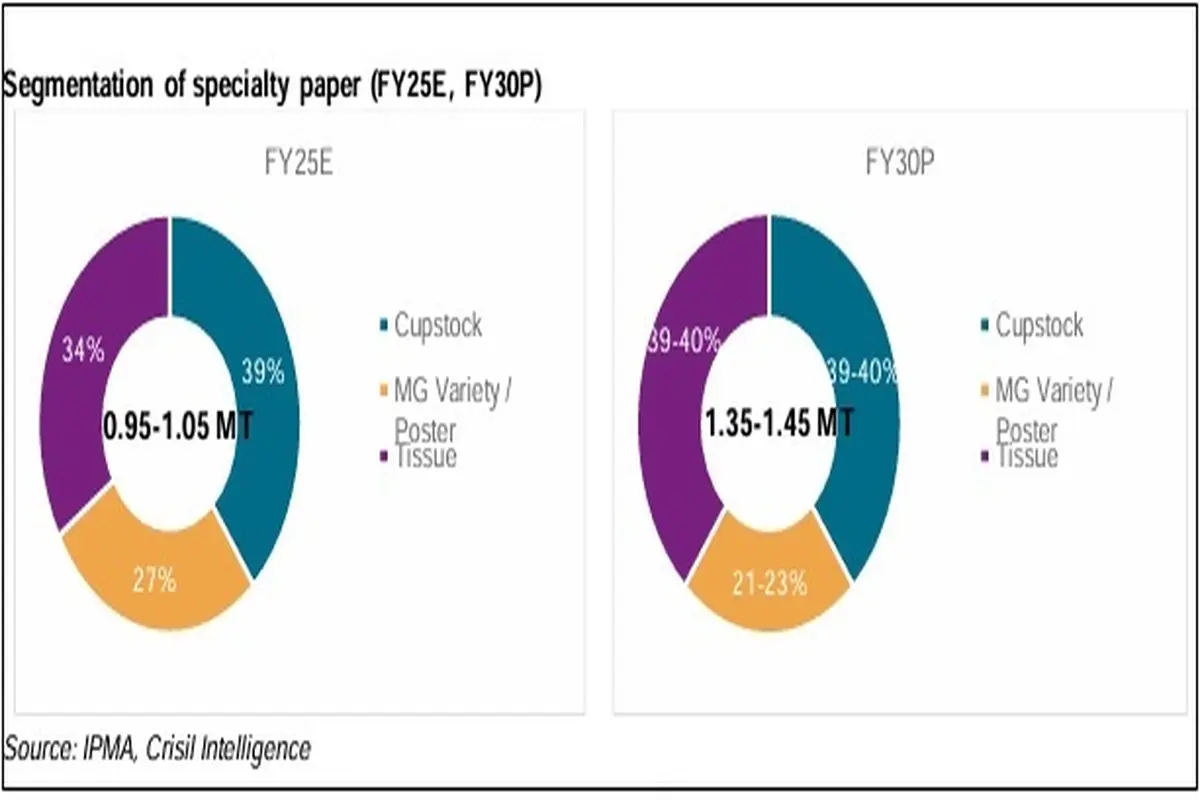
Cupstock paper had the highest share in the speciality paper segment at 39% in FY25E
Cupstock paper, a type of specialty paper designed specifically for manufacturing paper cups, is a crucial component in the packaging industry. It is typically made from a combination of wood pulp and other materials, and is characterized by its high strength, water resistance, and printability. As a key segment in the specialty paper market, cup stock paper accounted for 39% of the market share, followed by MG Variety/Poster at 27%, and Tissue at 34% in FY25. Going forward, the tissue paper segment is expected to grow the fastest within the specialty paper segment at 8-10% on account of increased focus on hygiene and health and reach a share of 39-40% in FY30. The Cupstock segment is expected to grow at 6-8% from FY25 to FY30 on account of increasing consumer preference for sustainable and eco-friendly packaging solutions, particularly in the food and beverage industry, and expected to maintain its share of ~39-40% in FY30. While the MG Variety / Poster paper segment is expected to see its share fall from 27% in FY25 to 21-23% in FY30. Overall, the specialty paper segment is expected to exhibit a growth of 6-7% from 0.95-1.05 MT in FY25 to 1.35-1.45 MT in FY30 mainly attributed to the increasing demand for sustainable and eco-friendly packaging solutions, and rising awareness about the environmental impact of single use plastics.

20 hours ago
Total Views : 1582
2 days ago
Total Views : 542

4 days ago
Total Views : 1216
last week
Total Views : 3560
last week
Total Views : 2608
last week
Total Views : 758
last week
Total Views : 3488
2 weeks ago
Total Views : 3552
2 weeks ago
Total Views : 6862

2 weeks ago
Total Views : 1054